


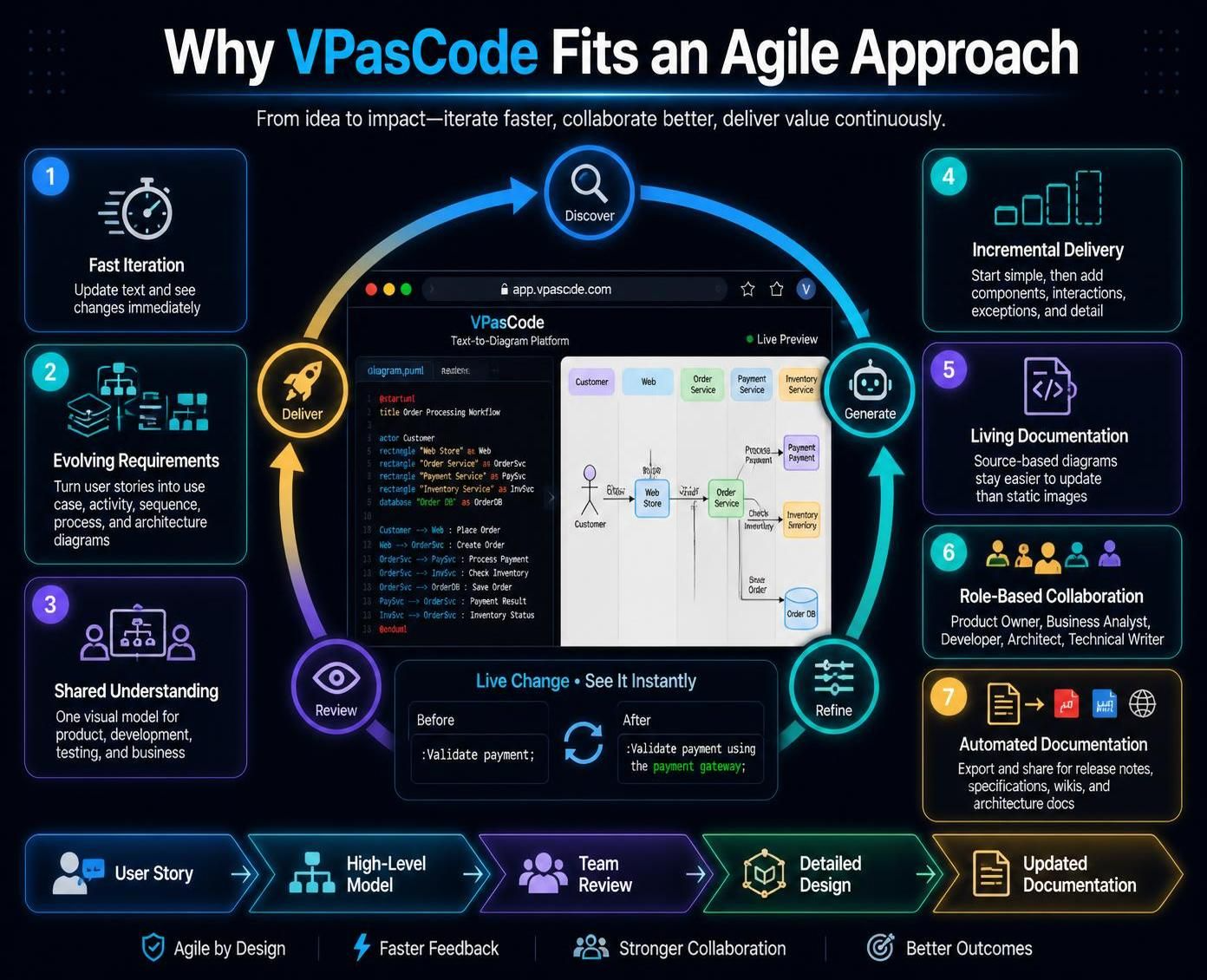
In the fast-paced world of software development, the gap between requirements and documentation is often where projects get stuck. Traditional diagramming tools often require static images that become outdated the moment a sprint ends. Enter VPasCode, a tool that fundamentally shifts the paradigm from “drawing” diagrams to “writing” models. This tutorial explores the system architecture of VPasCode and how its text-based approach perfectly aligns with Agile methodologies, enabling teams to iterate faster and collaborate better.
The Core Philosophy: Text-Based Modeling
At its heart, VPasCode operates on a “Text-to-Diagram” architecture. Unlike traditional GUI-based tools where users drag and drop shapes, VPasCode treats diagrams as source code. This approach leverages the same efficiency developers already use for writing application logic.
Why Text?
- Version Control: Just like application code, text-based diagrams can be tracked in Git, allowing teams to see exactly who changed a line and when.
- Searchability: You can search for specific terms within your diagrams, making large architectural models easier to navigate.
- Portability: Text files are lightweight and can be edited in any text editor, not just the specific proprietary tool.
The Agile Workflow: From User Story to Living Diagram
The infographic outlines a seamless “Discover, Generate, Refine, Review, Deliver” loop. Here is how you apply this workflow in a real-world Agile environment.
1. Describe the Requirement
The process begins with a User Story or a high-level requirement. Instead of immediately opening a drawing canvas, you start by describing the logic in natural language. VPasCode acts as an interpreter for these requirements.
2. Generate the First Diagram
Using the VPasCode engine, you convert that text description into a visual model. Whether it is a Sequence Diagram showing the flow of messages between a “Customer” and an “Order Service,” or an Architecture Diagram, the AI or syntax engine renders the structure instantly.
3. Refine and Edit
This is where the “Agile” advantage shines. If the Product Owner requests a change—say, adding a “Payment Service”—you don’t need to redraw arrows. You simply add a line of text to the source code. The diagram updates immediately in the “Live Preview” pane.
4. Review and Collaborate
The shared visual model ensures that developers, designers, and stakeholders are looking at the same reality. Because the source code is the single source of truth, technical debt regarding documentation is significantly reduced.
System Architecture & Key Concepts
Understanding how VPasCode structures its data helps in mastering the tool. The system relies on a declarative syntax where the structure of the diagram is defined by the hierarchy and relationships described in the text.
Key Components:
- Actors & Entities: Represented as stick figures or rectangles, these define the “who” of the system (e.g., Customer, Web Store).
- Components: These are the functional blocks, such as “Order Service” or “Inventory DB.”
- Interactions: The arrows and flow lines that describe the movement of data or commands between components.
By defining these elements in code, you ensure that the diagram remains a Living Documentation artifact rather than a static snapshot.
Benefits for the Agile Team
Adopting a text-based modeling tool like VPasCode brings specific advantages to the Agile lifecycle:
- Fast Iteration: Text is faster to type than to draw. Updating a relationship or adding a new actor is a matter of seconds, allowing the documentation to keep pace with rapid sprint changes.
- Shared Understanding: The visual output provides a common language. A Business Analyst can write the logic, and the Developer can instantly see how it translates into a technical architecture.
- Role-Based Collaboration: The tool supports inputs from Product Owners, Business Analysts, Developers, and Architects, ensuring everyone contributes to the “Single Source of Truth.”
Conclusion
VPasCode represents a maturation of the modeling process. By treating diagrams as code, it bridges the gap between the abstract requirements of Agile and the concrete reality of software architecture. It transforms documentation from a chore into a living, breathing part of the development workflow, ensuring that your system design is always as up-to-date as your application code.