


Visual Paradigm‘s AI-Powered Value Chain Analysis Tool is a revolutionary AI-powered business analysis software that transforms how companies conduct strategic assessments. This tool is not just another diagramming app; it’s a sophisticated, guided platform designed to generate a comprehensive value chain analysis in minutes. The process begins with a simple input: your business name and industry context. As demonstrated in the first image, a user can input details for a company like “PureNature Organics” in the “Organic Food Production” industry. The tool then leverages AI to generate a full analysis, guiding the user through a structured 7-step workflow. This workflow covers all primary activities—Inbound Logistics, Operations, Outbound Logistics, Marketing & Sales, and Service—and essential support activities like Human Resources and Technology. The result is a professional, actionable report that provides a clear, strategic view of the business’s value creation process. This value chain analysis tool is a powerful asset for business strategists, operations managers, and consultants who need to quickly identify competitive advantages and optimize processes.
Key Takeaways
-
Visual Paradigm’s AI-Powered Value Chain Analysis Tool is an AI-powered business analysis software that generates comprehensive reports in minutes.
-
It uses a guided 7-step workflow to analyze all primary and support activities of a business.
-
Users input their business context, and the AI generates a detailed analysis, which can be edited and refined.
-
The final output is a professional report that can be printed or saved as a PDF.
-
The tool ensures data privacy by saving all analysis locally on the user’s computer.
How the AI-Powered Value Chain Analysis Tool Works
At its core, the AI-Powered Value Chain Analysis Tool operates on a simple yet powerful premise: to provide a structured, AI-assisted framework for analyzing a business’s value creation process. The journey begins with the user defining their business. As shown in
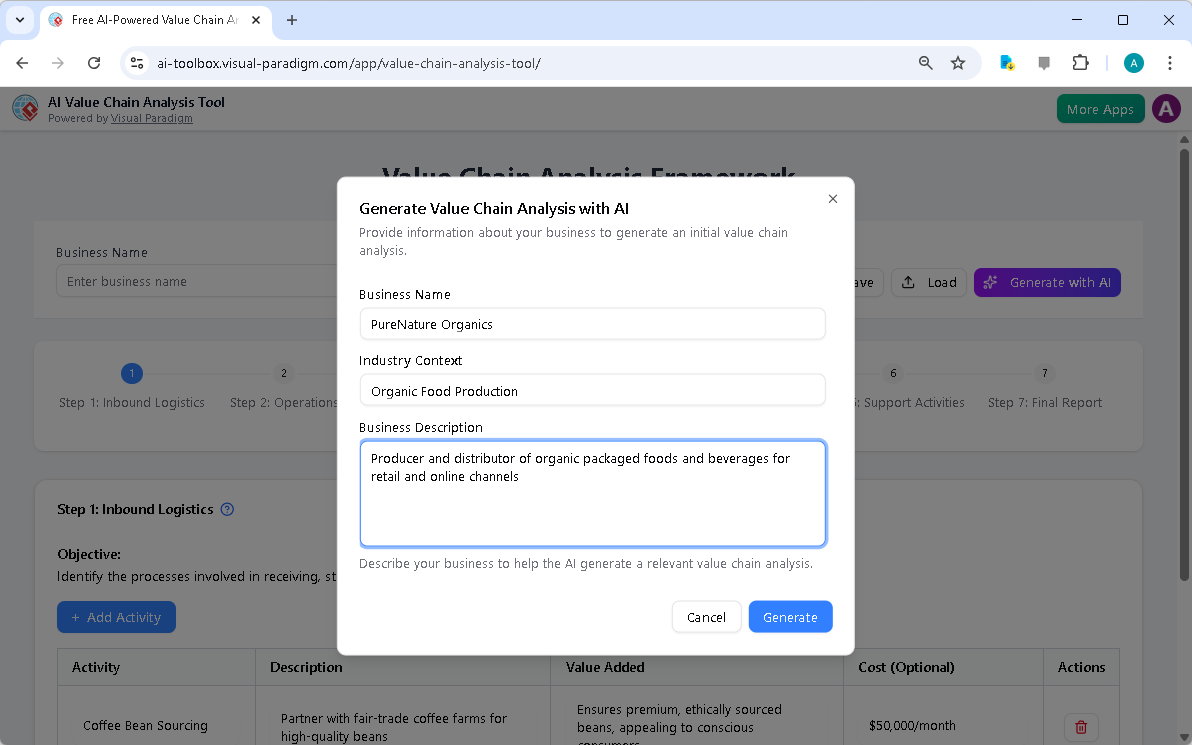
, the user enters the business name (“PureNature Organics”), industry context (“Organic Food Production”), and a brief description. This contextual information is crucial because it allows the AI to generate a highly relevant and plausible initial analysis. The AI doesn’t just provide generic suggestions; it tailors its output to the specific business model, ensuring the generated activities, value added, and costs are relevant. Once the initial data is provided, the user clicks “Generate with AI,” and the tool populates the first step, “Inbound Logistics,” with a set of suggested activities. This is where the tool’s true power becomes evident. The AI acts as a strategic consultant, rapidly outlining the foundational processes of the business.
Step 1: Inbound Logistics
After the AI generates the initial analysis, the user is presented with the first step of the workflow: Inbound Logistics. As seen in
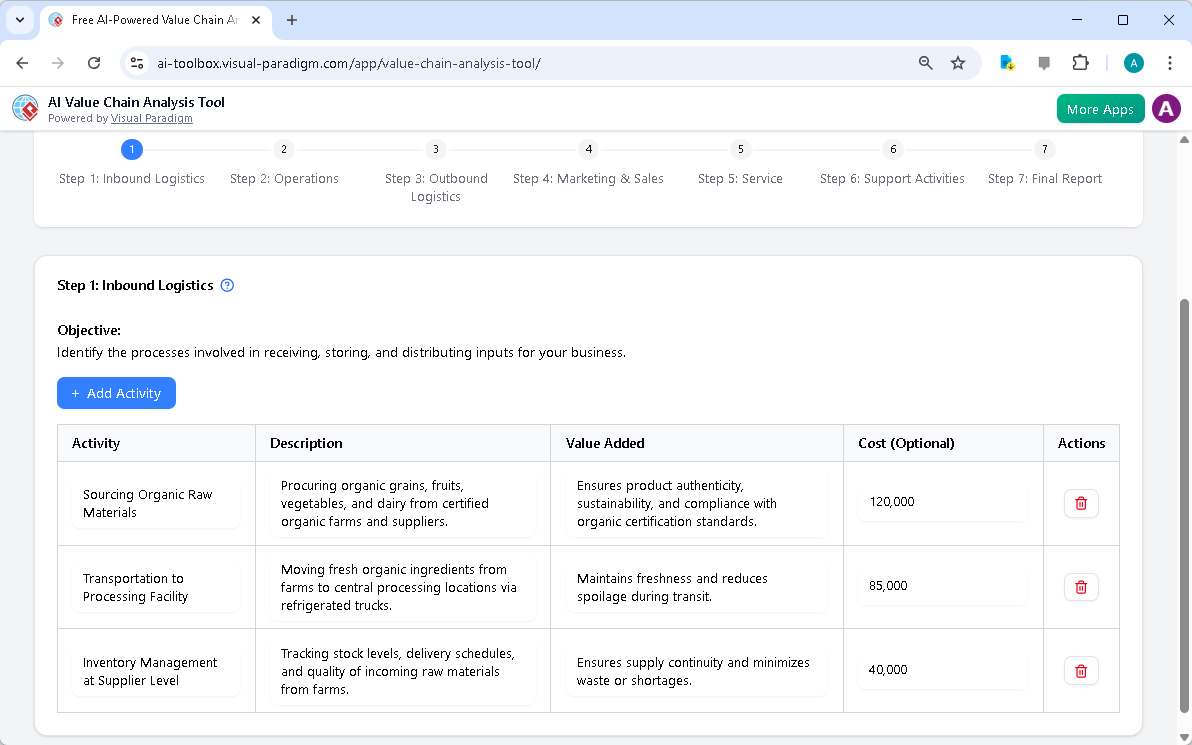
, the tool has populated the table with activities such as “Sourcing Organic Raw Materials” and “Transportation to Processing Facility.” Each activity is accompanied by a description, a value-added statement, and an optional cost estimate. This is not just a list; it’s a structured assessment of the inputs that fuel the business. The user can then review and refine these AI-generated suggestions. For instance, the user might add more specific details to the description or adjust the cost based on their actual data. The dynamic table allows for easy editing, making the process intuitive and efficient.
Step 2: Operations
Progressing to Step 2, the user focuses on the core transformation process.
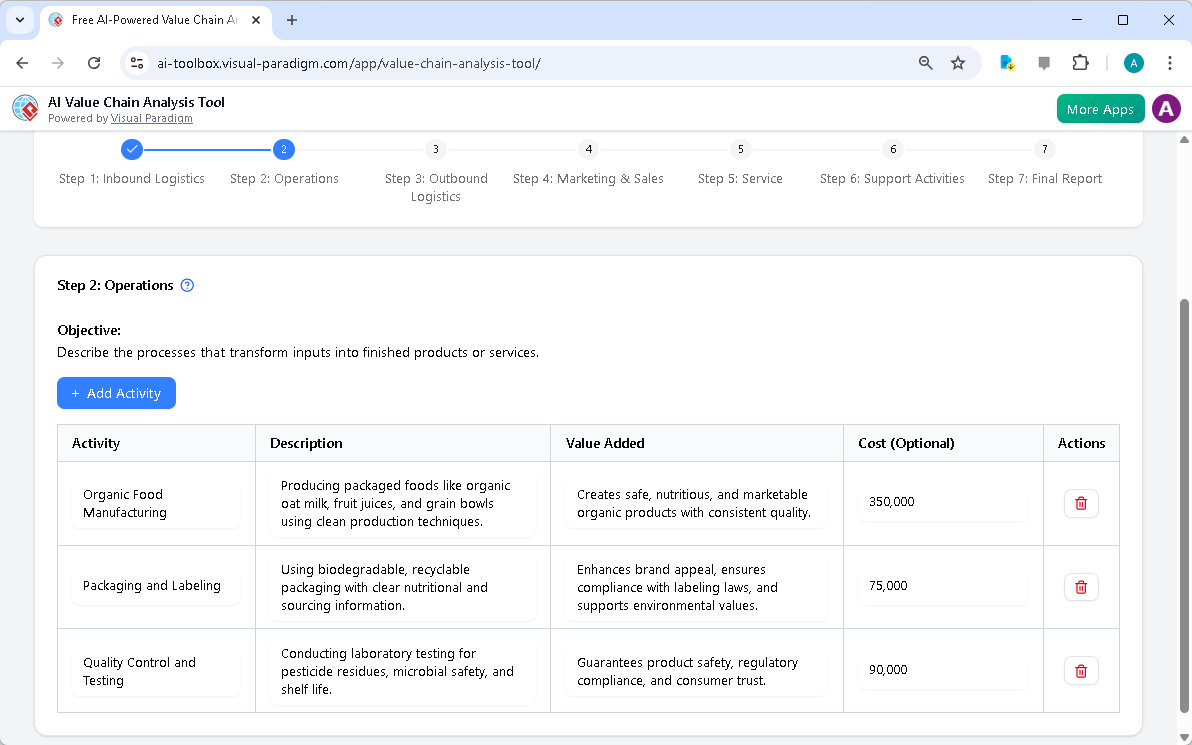
shows the “Operations” step, where the AI has generated activities like “Organic Food Manufacturing” and “Packaging and Labeling.” The tool prompts the user to describe the processes that convert raw materials into finished products. This step is critical for understanding the value created during production. The AI suggests that manufacturing creates “safe, nutritious, and marketable organic products,” while packaging enhances brand appeal. The user can validate these statements and add their own insights, such as specific quality control procedures or the use of sustainable materials. The ability to quantify the value added and cost of each operation provides a clear picture of the business’s production efficiency.
Step 3: Outbound Logistics
Next, the analysis moves to Step 3: Outbound Logistics. As depicted in
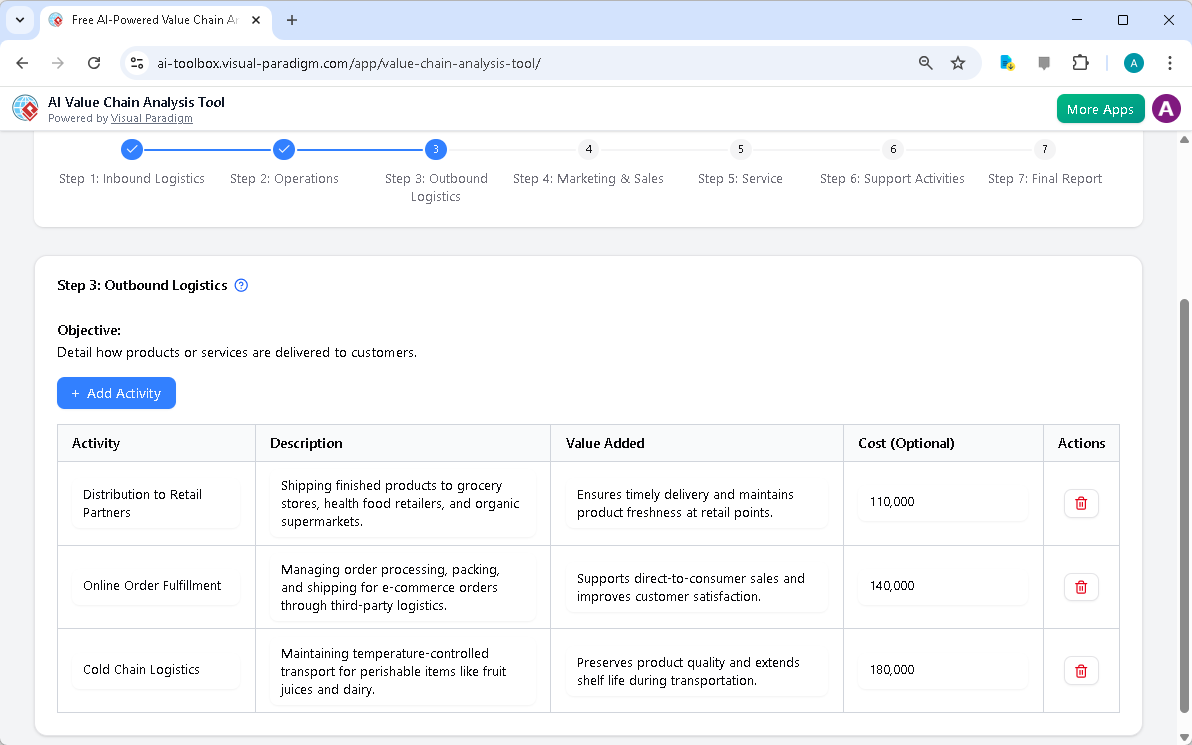
, the focus shifts to how the finished product is delivered to the customer. The AI has generated activities like “Distribution to Retail Partners” and “Online Order Fulfillment.” This step examines the effectiveness of the supply chain in getting the product to the end user. The user can assess the value added by ensuring timely delivery and maintaining product freshness, which are key for a perishable product like organic food. The cost estimates provided by the AI, such as $110,000 for retail distribution, can serve as a benchmark for the user to compare against their actual expenses and identify potential areas for cost reduction or optimization.
Step 4: Marketing & Sales
Step 4, “Marketing & Sales,” is where the business’s value proposition is communicated to the market.
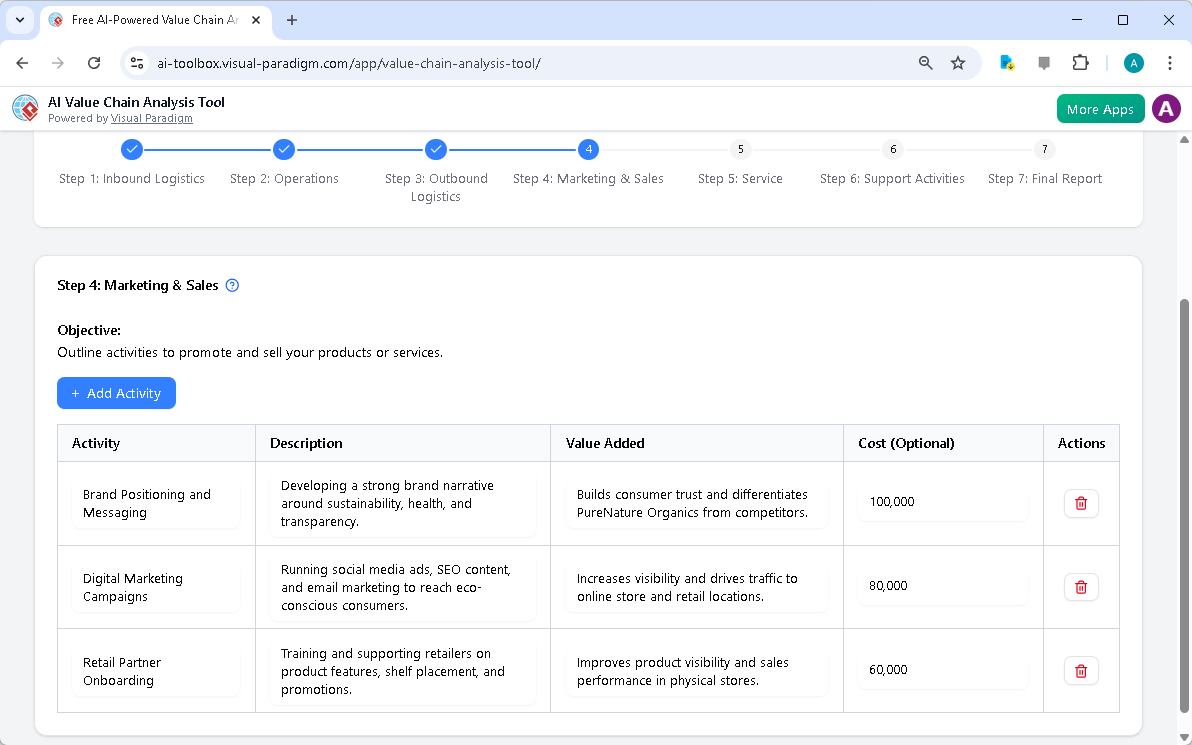
illustrates this step, with the AI suggesting activities like “Brand Positioning and Messaging” and “Digital Marketing Campaigns.” The tool helps the user articulate how the business builds consumer trust and drives traffic. The AI suggests that strong branding around sustainability and health differentiates the company from competitors. The user can refine these strategies, perhaps by adding a specific social media campaign or a new retail partnership. This step is vital for identifying the sources of competitive advantage in the market.
Step 5: Service
Step 5 focuses on the post-sale experience.
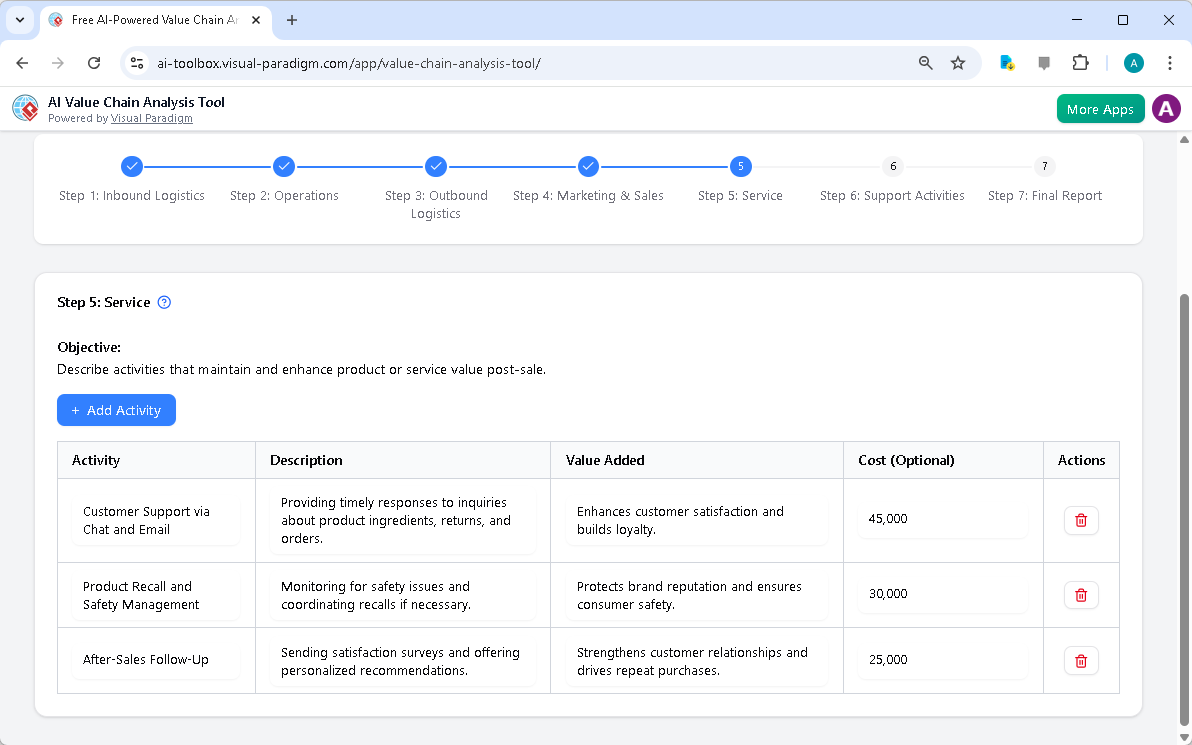
shows the “Service” step, where the AI has generated activities such as “Customer Support via Chat and Email” and “Product Recall and Safety Management.” This step is crucial for maintaining customer loyalty and protecting the brand’s reputation. The AI suggests that timely customer support enhances satisfaction, while effective recall management protects brand safety. The user can add specific details about their customer service team or their crisis management protocols. This analysis helps the business understand how its service activities contribute to long-term customer relationships.
Step 6: Support Activities
Step 6, “Support Activities,” delves into the internal functions that enable the primary activities.
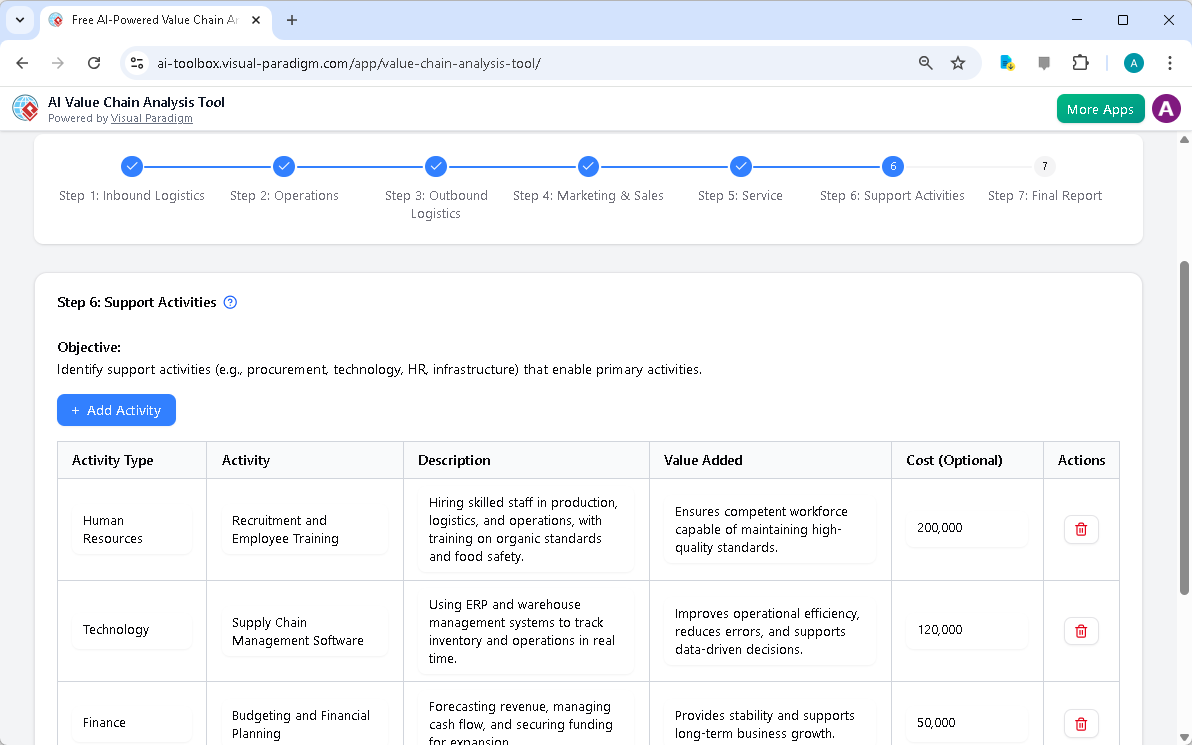
shows the AI-generated activities in this category, including “Recruitment and Employee Training” and “Supply Chain Management Software.” These activities are often overlooked but are essential for the overall efficiency of the business. The AI suggests that skilled staff are vital for maintaining high-quality standards and that technology systems improve operational efficiency. The user can refine these suggestions by adding details about their HR policies or the specific software they use. This step helps the business understand the underlying infrastructure that supports its value chain.
Step 7: Final Report
The culmination of the analysis is the Final Report, shown in
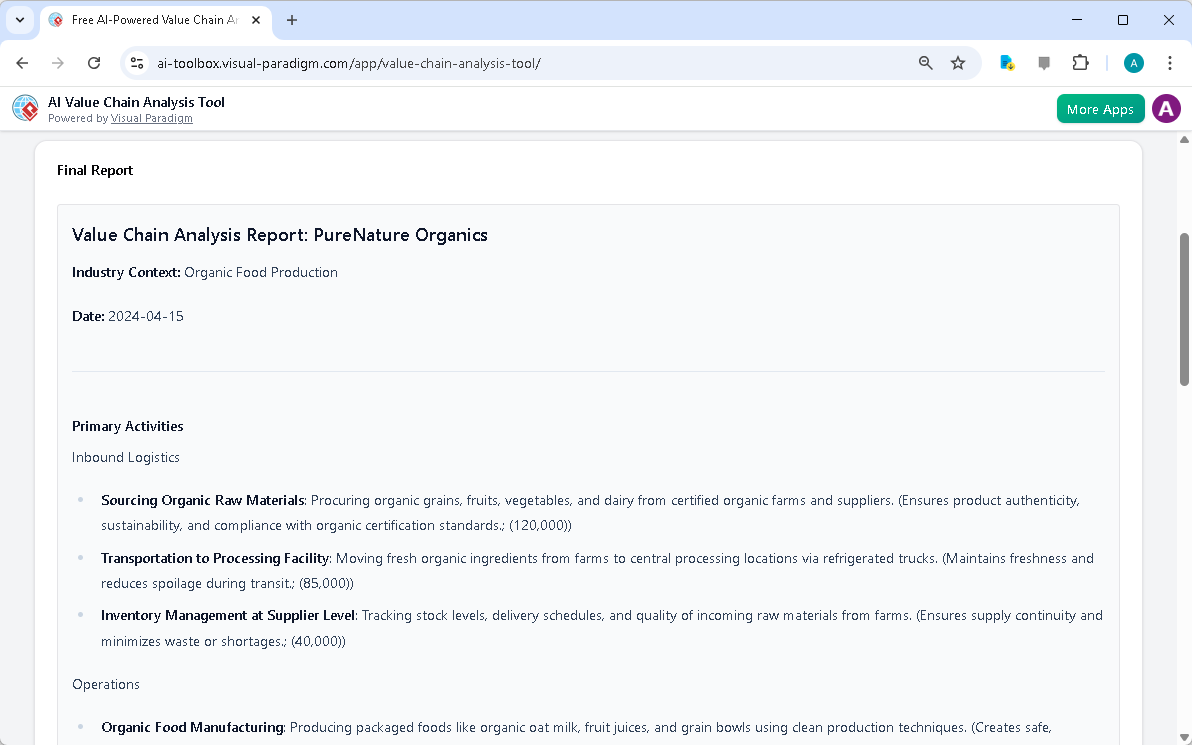
. This step consolidates all the information gathered in the previous six steps into a single, professional document. The report clearly lays out the value chain for “PureNature Organics,” detailing each activity, its description, value added, and cost. The user can now review the entire analysis to identify key insights. For example, they might notice that the cost of “Cold Chain Logistics” is high, indicating a potential area for optimization. The report is designed to be shared with stakeholders, making it an excellent tool for strategic discussions. The user can print the report or save it as a PDF for future reference. This final output is a powerful strategic document that can guide business decisions and drive growth.
Why This AI-Powered Value Chain Analysis Tool is a Game-Changer
Traditional value chain analysis is often a time-consuming and complex process, requiring significant research and expertise. The AI-Powered Value Chain Analysis Tool democratizes this process by making it accessible and efficient. It is not a replacement for human insight but a powerful assistant that accelerates the analysis process. By providing a structured, guided workflow, it ensures that no critical component of the business is overlooked. The AI-generated initial draft serves as a robust starting point, allowing users to focus their efforts on validation and strategic refinement rather than on the initial data collection. This tool is ideal for business strategists who need to quickly generate insights, operations managers looking to optimize processes, and consultants who need to deliver professional analyses to clients. The ability to save and load projects ensures that the analysis is a living document that can be revisited and updated over time. For businesses like PureNature Organics, this tool provides a clear roadmap to enhance their competitive advantage and achieve sustainable growth.
Ready to unlock the strategic potential of your business? Try the AI-Powered Value Chain Analysis Tool today and transform your business analysis process.
Related Links
-
Value Chain Analysis Tool – Visual Paradigm: The Value Chain Analysis Tool delivers outputs that seamlessly integrate into your management and operational strategies: Comprehensive Activity Breakdown: A step-by-step analysis of each primary and support activity…
-
Online Value Chain Analysis Tool: Take a look at how Visual Paradigm Online can help you create diagrams quickly and collaboratively. Easy drag-and-drop tools to help you create diagrams in minutes.
-
Value Chain Analysis Tool: The Value Chain Analysis Tool helps you systematically analyze your business activities using Porter’s Value Chain framework to identify competitive advantages and optimization opportunities .
-
What is Value Chain Analysis? | Business Guide – Visual Paradigm AI: Instead of a messy whiteboard or a confusing spreadsheet, our tool gives you a clear, interactive framework to map these activities, assign costs, and identify value .
-
Value Chain Analysis Templates: Create value chain analysis diagrams online. Visual Paradigm Online features an easy online value chain analysis tool and a large variety of technical and business diagram templates .
-
Visual-paradigm: Discover Visual Paradigm’s innovative AI-powered software and comprehensive support for intelligent application development. Empower your projects with advanced AI tools.
-
The Best Online Value Chain Analysis Diagram Tool: Value chain analysis is used as a tool for identifying activities, within and around the firm and relating these activities to an assessment of competitive strength. ..
-
Free Mind Map Template: Value Chain Analysis: This comprehensive approach allows organizations to identify strengths, weaknesses, and areas for improvement across the entire value chain, fostering strategic decision-making and continuous improvement…