


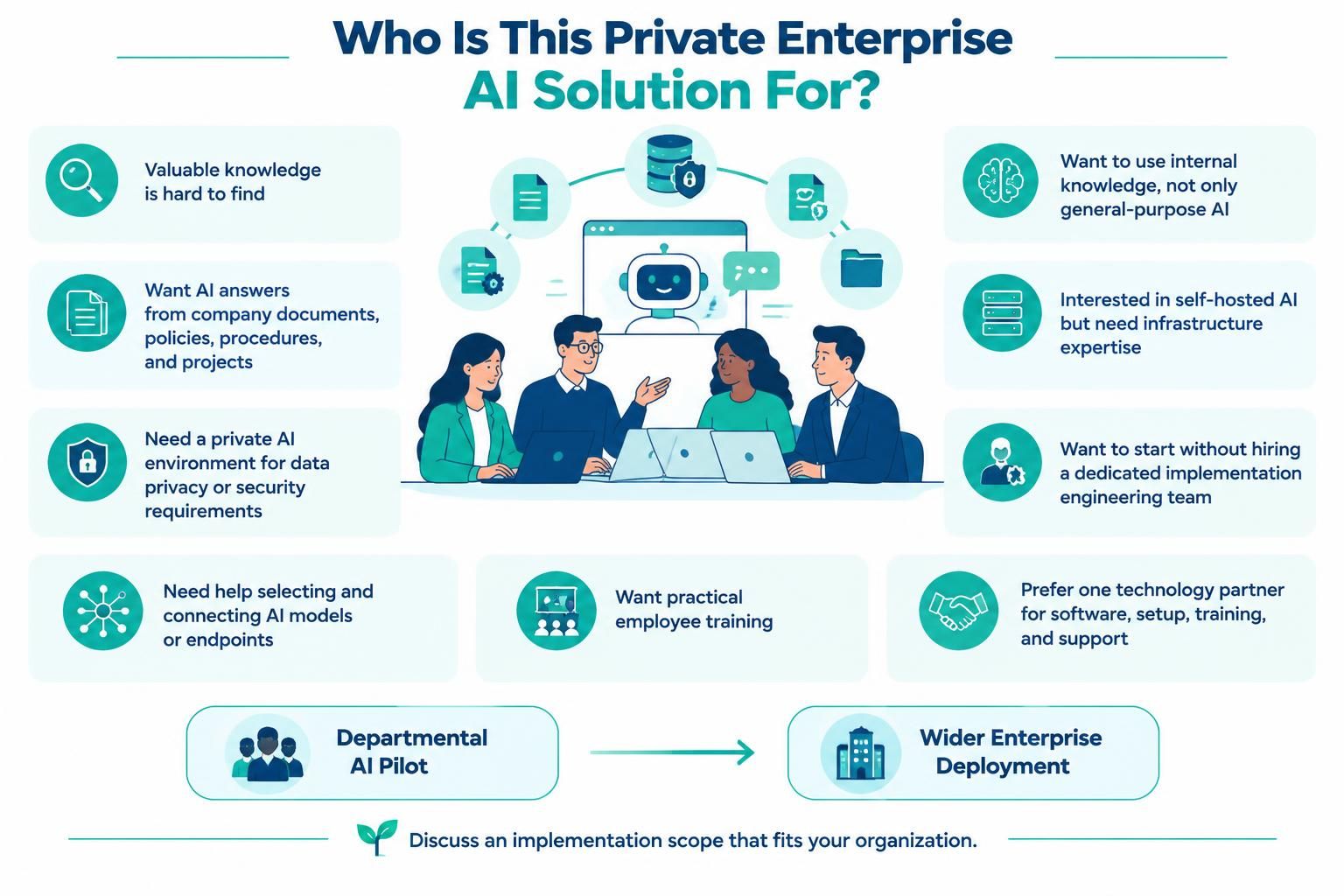
In the current landscape of enterprise technology, the gap between the availability of Artificial Intelligence and its practical, secure application is often defined by organizational data silos. Many companies possess vast repositories of internal knowledge—policies, project files, and historical data—that are difficult for employees to access, leading to inefficiencies and duplicated efforts.
This tutorial explores the architecture of a Private Enterprise AI Solution. We will move away from generic, public AI models and instead design a system that leverages the Visual Paradigm ecosystem to create a secure, self-hosted environment. This approach ensures that your organization’s proprietary data remains private while providing employees with powerful AI assistance.
The Architecture of a Private AI Environment
Unlike consumer-grade AI tools that rely on public training data, a private enterprise solution requires a distinct architectural approach. The goal is to connect your existing internal knowledge base with AI inference engines without exposing sensitive data to the public cloud.
The core of this system rests on three pillars:
- Visual Paradigm Ecosystem: The interface for managing workflows and business logic.
- AI Core Components: The backend intelligence (LLMs) that processes natural language queries.
- Training and Setup: The human layer that ensures adoption and correct configuration.
1. The “Private” Aspect: Why Self-Hosted Matters
Security and compliance are the primary drivers for a private solution. By choosing a self-hosted AI environment, the organization retains full control over the data infrastructure. This is critical for industries with strict regulatory requirements or for companies that simply cannot risk data leakage.
In this architecture, the AI does not send your company documents to a third-party server. Instead, the AI models are deployed locally or within a secure internal network, interacting directly with your internal databases.
2. Bridging the Knowledge Gap
One of the most common challenges is that valuable knowledge is often hard to find. Employees spend hours searching for documents rather than creating them. The solution involves implementing a Retrieval-Augmented Generation (RAG) pattern.
Here is how the data flows in our proposed system:
- Ingestion: Company documents (PDFs, policies, procedures) are ingested into a vector database.
- Querying: An employee asks a question via a natural language interface.
- Retrieval: The system searches the internal knowledge base for relevant context.
- Generation: The AI synthesizes the retrieved information into a clear, concise answer.
Visualizing the Implementation: From Pilot to Enterprise
Implementing this technology does not require a massive overhaul of your IT infrastructure. The recommended approach is a phased deployment, starting with a Departmental AI Pilot before expanding to a Wider Enterprise Deployment.
This visual progression ensures that the system is stable and useful before scaling. It allows you to:
- Test the infrastructure with a specific use case.
- Gather feedback from early adopters.
- Refine the training materials and AI tuning.
- Finally, scale the solution to the entire organization.
The Role of the Technology Partner
A significant barrier to entry is the lack of technical expertise to set up the infrastructure independently. This is where a comprehensive technology partner becomes essential. Rather than hiring a dedicated engineering team for the initial implementation, organizations can leverage an experienced partner to handle:
- Model Selection: Choosing the right AI models for specific tasks.
- Endpoint Connectivity: Connecting the models to your internal data sources.
- Training: Providing practical training for employees to use the new tools effectively.
Step-by-Step: Building the Model
To visualize the integration of the Visual Paradigm ecosystem with AI Core Components, we can define a simple system context. This diagrammatic approach helps stakeholders understand the data boundaries and interaction points.
Below is a Mermaid diagram representing the high-level architecture of this Private Enterprise AI Solution.
graph TD
    subgraph "External Users & Departmental Pilot"
        User[Employee]
        Dept[Departmental Pilot]
    end

    subgraph "Visual Paradigm Ecosystem"
        VP_UI[User Interface]
        VP_Log[Workflow Logic]
    end

    subgraph "AI Core Components (Private/Self-Hosted)"
        LLM[AI Model / LLM]
        VectorDB[(Vector Database)]
        PolicyDB[(Internal Docs)]
    end

    subgraph "Support & Infrastructure"
        Setup[Setup & Training]
        Support[Technical Support]
    end

    User -->|Ask Question| VP_UI
    VP_UI -->|Query| LLM
    LLM -->|Retrieve Context| VectorDB
    VectorDB -->|Load Data| PolicyDB
    LLM -->|Generate Answer| VP_UI
    VP_UI -->|Display| User

    Setup --> VP_UI
    Setup --> LLM
    Support --> VP_UI

    Dept -->|Expand Scope| VP_Log
    VP_Log -->|Scale| WiderEnterprise
    WiderEnterprise[Enterprise Deployment]

    style LLM fill:#f9f,stroke:#333,stroke-width:2px
    style VectorDB fill:#bbf,stroke:#333,stroke-width:2px
    style PolicyDB fill:#bbf,stroke:#333,stroke-width:2px
Understanding the Diagram
In the architecture above, notice the flow of data. The “Employee” interacts with the “Visual Paradigm Ecosystem,” which acts as the gateway. Crucially, the “AI Model” and the “Vector Database” are isolated within the Private/Self-Hosted boundary. This ensures that even if the external interface is compromised, the core data remains secure.
The “Setup & Training” component feeds into the system, ensuring that the models are tuned to the specific context of the organization’s documents and policies.
Conclusion: A Strategic Approach to AI
The transition to Private Enterprise AI is not just about technology; it is about managing knowledge and security. By leveraging the Visual Paradigm ecosystem and a structured implementation plan, organizations can introduce powerful AI capabilities without compromising their data privacy.
Whether you are starting with a departmental pilot or aiming for a wider enterprise deployment, the key lies in selecting the right partners and establishing a robust, self-hosted infrastructure that serves your unique business needs.