This is a demo site showcasing flipbooks created with Visual Paradigm Online.

Category Archives: Unified Modeling Languages

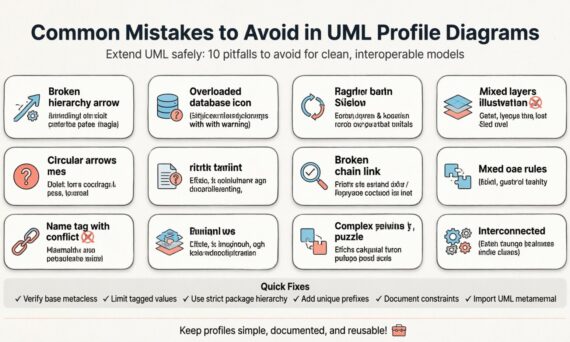
Common Mistakes to Avoid in UML Profile Diagrams

Common Mistakes to Avoid in UML Profile Diagrams

Creating a robust UML Profile is a critical step in extending the Unified Modeling Language to fit specific domain requirements. Profiles allow modelers to define new concepts, or stereotypes, without altering the core UML specification. However, this extension mechanism is powerful yet prone to errors. When implemented incorrectly, a profile can introduce ambiguity, break model
Read More

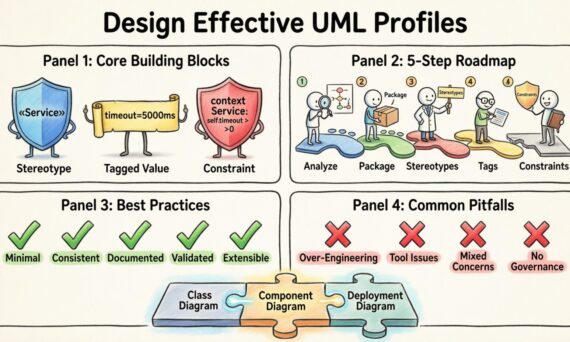
How to Design Effective UML Profile Diagrams

How to Design Effective UML Profile Diagrams

Unified Modeling Language (UML) provides a standardized visual language for software architecture. However, generic diagrams often lack the specificity required for complex domain-specific systems. This is where the UML Profile mechanism becomes essential. A profile allows you to extend the core UML metamodel without altering its fundamental rules. By designing effective profile diagrams, you create

Read More

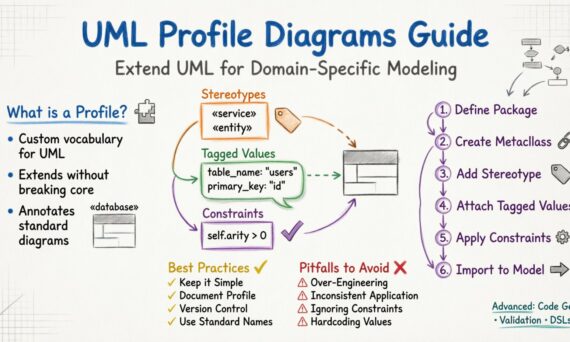
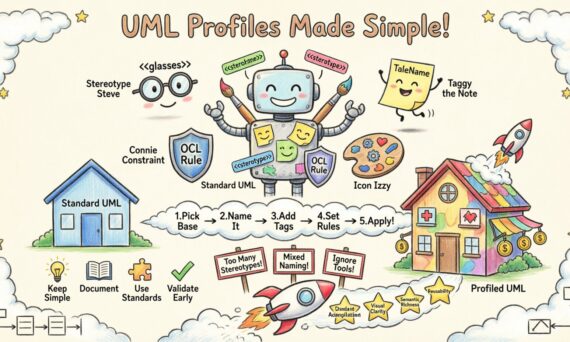
Extending Standard UML with Profile Diagrams: A Guide

Extending Standard UML with Profile Diagrams: A Guide

Unified Modeling Language (UML) provides a standardized way to visualize, specify, construct, and document the artifacts of a software system. However, the standard set of diagrams and notations often requires adaptation to fit specific domains, industries, or architectural styles. This is where the concept of UML Profiles becomes essential. A profile allows modelers to extend

Read More

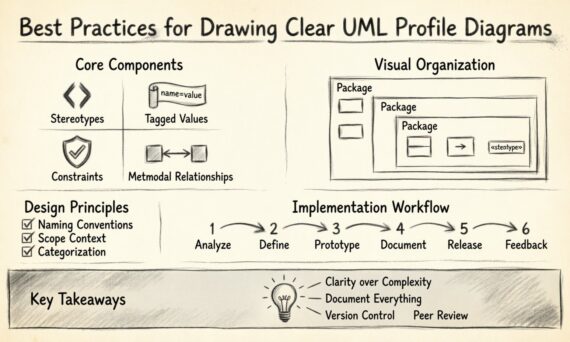
Best Practices for Drawing Clear UML Profile Diagrams

Best Practices for Drawing Clear UML Profile Diagrams

Unified Modeling Language (UML) provides a standardized way to visualize the design of a system. However, standard UML diagrams often lack the specificity required for complex domain modeling. This is where UML Profile Diagrams become essential. A profile extends the UML metamodel without changing its core semantics, allowing architects to define domain-specific constructs. These constructs

Read More

Mid-Level Developer’s Handbook to UML Profile Diagrams

Mid-Level Developer’s Handbook to UML Profile Diagrams

Software architecture relies heavily on clear communication. When teams build complex systems, standard diagrams often reach their limits. This is where the UML Profile Diagram becomes essential. For a mid-level developer, understanding how to extend the Unified Modeling Language (UML) without breaking its core structure is a critical skill. This guide explores the mechanics, applications,

Read More

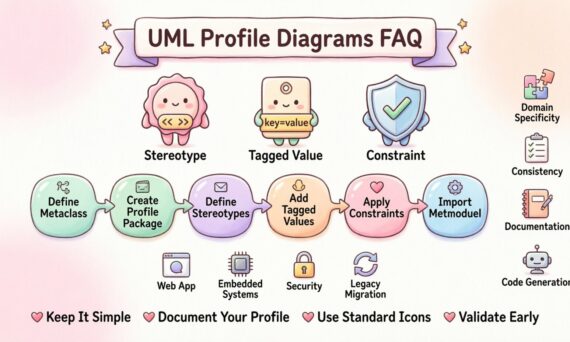
Frequently Asked Questions About UML Profile Diagrams

Frequently Asked Questions About UML Profile Diagrams

Unified Modeling Language (UML) serves as the backbone for software architecture, providing a standardized notation for visualizing system designs. However, standard UML is generic. It does not always account for specific industry requirements, legacy constraints, or specialized domains like embedded systems or cloud computing. This is where the UML Profile Diagram becomes a critical tool

Read More

Detailed Analysis of Interaction Overview Diagram in Visual Paradigm for Scheduling Systems

This note provides a comprehensive analysis of the interaction overview diagram (IOD) for a scheduling system, as described in the provided attachment, focusing on key concepts, tips, and tricks within the context of a visual paradigm. The analysis aims to cover all aspects relevant to modeling and designing scheduling systems, ensuring clarity for both technical

Read More