


Unified Modeling Language (UML) profiles serve as the backbone for extending standard modeling notations to fit specific domains. As software architectures grow in complexity, the need for tailored modeling approaches becomes critical. This guide explores the trajectory of UML profile diagram usage, examining how these diagrams adapt to modern development practices. We will analyze the shift from static documentation to dynamic, integrated modeling environments.
1. The Evolution of Domain Specific Extensions 📈
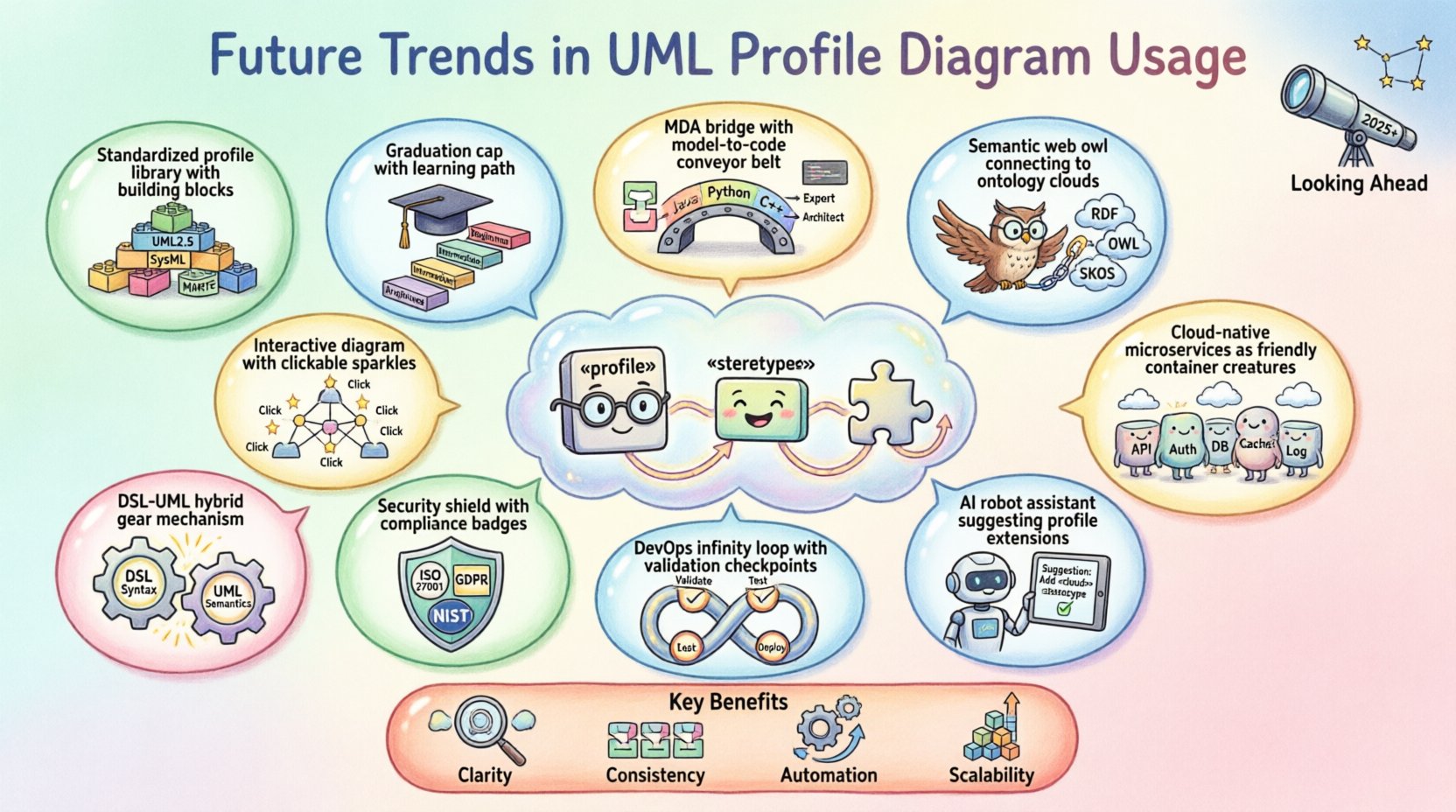
Profiles allow modelers to add stereotypes, tags, and constraints to the base UML metamodel. Historically, these were created in isolation for specific projects. The future lies in standardization and reusability. We are moving towards a landscape where profiles are treated as first-class citizens in the architecture, rather than ad-hoc additions.
- Standardization: Organizations are increasingly adopting industry-wide profile standards to ensure consistency across teams.
- Reusability: Libraries of pre-defined profiles are becoming common, reducing the time spent on defining basic extensions.
- Modularity: Profiles are being designed to be composed, allowing smaller domains to be layered over larger ones.
This shift reduces cognitive load. Engineers can focus on the logic of the system rather than the syntax of the diagram. The goal is to make the modeling language as intuitive as the code it represents.
2. Integration with Model-Driven Architecture 🏗️
Model-Driven Architecture (MDA) relies heavily on the abstraction of design details. UML profiles play a pivotal role in this by bridging the gap between platform-independent models and platform-specific implementations. The trend here is tighter integration between the model and the code generation engines.
When a profile is defined correctly, it dictates how transformations occur. Future developments will see profiles directly influencing the generation of configuration files, deployment scripts, and API contracts. This creates a single source of truth where changes in the model propagate automatically through the stack.
- Automated Transformation: Profiles define the rules for converting abstract designs into concrete artifacts.
- Consistency Checks: Automated tools will validate that generated code adheres strictly to the profile constraints.
- Traceability: Links between model elements and generated code will be maintained automatically.
3. Semantic Web and Ontology Alignment 🧠
As systems become more distributed, understanding the meaning of data and interactions is crucial. UML profiles are increasingly being aligned with semantic web standards. This involves mapping stereotypes to ontology concepts, allowing for automated reasoning over the model.
This trend enables systems to understand relationships beyond simple structural connections. For instance, a profile element can be linked to a specific business rule or compliance requirement stored in an external knowledge graph. This adds a layer of intelligence to the modeling process.
| Traditional Profile | Semantic Profile |
|---|---|
| Defines visual notation | Defines meaning and logic |
| Static documentation | Dynamic knowledge representation |
| Manual interpretation | Automated reasoning support |
4. Cloud-Native and Microservices Contexts ☁️
The rise of cloud-native computing has introduced new architectural patterns. Containers, orchestration, and service meshes require new ways of modeling. UML profiles are evolving to represent these specific infrastructure concerns.
Instead of just modeling software classes, profiles now model deployment units, network policies, and scaling rules. This ensures that the architectural design reflects the runtime environment accurately. It bridges the gap between development and operations.
- Infrastructure as Code: Profiles can define the parameters for infrastructure provisioning.
- Service Boundaries: Clear stereotypes help define the scope and responsibility of microservices.
- Resilience Patterns: Profiles can denote retry logic, circuit breakers, and fault tolerance mechanisms.
5. Artificial Intelligence in Model Generation 🤖
Artificial Intelligence and Machine Learning are beginning to influence how models are created. AI tools can analyze existing codebases and suggest appropriate UML profiles. They can also assist in generating initial model structures based on natural language requirements.
This does not replace the architect but augments their capabilities. AI can handle the repetitive task of setting up standard profiles, allowing humans to focus on complex domain logic. The models become more accurate because they are derived from actual code behavior.
- Code Analysis: AI scans source code to infer potential profile extensions.
- Recommendation Systems: Suggests the best profile for a specific architectural problem.
- Gap Detection: Identifies inconsistencies between the model and the implementation.
6. Continuous Modeling and DevOps Pipelines 🔄
DevOps culture emphasizes continuous integration and delivery. Modeling cannot be a one-time activity at the start of a project. Profiles must be versioned and validated within the CI/CD pipeline.
This trend ensures that the architecture evolves alongside the software. If a change violates a profile constraint, the build can fail immediately. This prevents architectural drift and keeps the documentation current.
- Version Control: Profiles are stored in repositories alongside code.
- Validation Gates: Automated checks ensure profile compliance before deployment.
- Feedback Loops: Runtime data informs updates to the profile definitions.
7. Security and Compliance Standardization 🔒
Security is no longer an afterthought. Profiles are being developed to explicitly model security requirements. This includes data classification, access control policies, and encryption standards.
By embedding security constraints into the profile, architects can ensure that security is built into the design from the beginning. This is particularly important for regulated industries where compliance is mandatory.
- Data Sensitivity: Stereotypes indicate the sensitivity level of data elements.
- Access Control: Profiles define who can interact with specific components.
- Audit Trails: Models can specify logging and auditing requirements.
8. Convergence with Domain Specific Languages 🛠️
Domain Specific Languages (DSLs) offer powerful ways to describe specific domains. UML profiles are converging with DSLs to provide the best of both worlds. The visual clarity of UML is combined with the precision of DSL.
This hybrid approach allows for high-level abstraction while maintaining the rigor needed for implementation. Profiles act as the bridge, translating DSL concepts into a universally understood notation.
- Interoperability: Allows different DSLs to communicate through a common model.
- Tooling Support: Leverages existing UML tools for DSL-based workflows.
- Flexibility: Adapts to changing domain requirements without rewriting the core language.
9. Enhanced Visualization and Interaction 🖼️
The way profiles are visualized is changing. Static diagrams are being replaced by interactive models. Users can click on elements to see detailed metadata, runtime statistics, or related documentation.
This interactivity makes the model a living artifact. It becomes a tool for exploration rather than just documentation. This is especially useful for onboarding new team members who need to understand the system architecture quickly.
- Interactive Elements: Clickable diagrams that reveal deeper layers of information.
- Dynamic Data: Real-time data visualization within the model view.
- Collaboration: Multiple users can view and annotate the model simultaneously.
10. Educational Shifts and Adoption Barriers 🎓
Despite the benefits, adoption faces challenges. Training is required to understand how to create and maintain effective profiles. The learning curve can be steep for teams new to advanced modeling.
Future trends include better educational resources and simplified profile creation tools. The goal is to lower the barrier to entry so that more teams can benefit from structured modeling. Mentorship and community sharing will play a key role.
- Training Programs: Structured courses on profile development.
- Community Repositories: Shared libraries of common profiles.
- Best Practices: Documentation of successful implementation patterns.
Implementation Considerations ⚠️
Adopting these trends requires careful planning. It is not enough to simply define a profile; it must be integrated into the workflow. The following points summarize key considerations for implementation.
- Scope Definition: Clearly define what the profile covers to avoid scope creep.
- Tooling Support: Ensure the modeling tools support the required profile features.
- Governance: Establish a process for reviewing and updating profiles.
- Team Alignment: Ensure all stakeholders agree on the profile semantics.
Summary of Key Benefits ✅
The evolution of UML profile diagrams offers significant advantages for modern software development. By adopting these trends, organizations can improve quality, reduce risk, and accelerate delivery.
- Clarity: Domain-specific notation makes complex systems easier to understand.
- Consistency: Standardized profiles ensure uniform design patterns.
- Automation: Integration with pipelines reduces manual effort.
- Scalability: Modular profiles allow for growth and adaptation.
Looking Ahead 🔭
The future of UML profiles is bright. As systems become more complex, the need for precise modeling will only increase. The integration with AI, cloud, and security standards will make profiles more powerful than ever. Organizations that invest in this area now will be better positioned for the challenges of tomorrow.
The journey involves continuous learning and adaptation. It is not a destination but a process of refinement. By staying informed about these trends, architects can ensure their models remain relevant and effective.
Remember that the value of a profile lies in its usage. A perfect profile that is never applied provides no benefit. The focus must remain on practical application and continuous improvement. This ensures that the modeling effort translates into tangible results.