


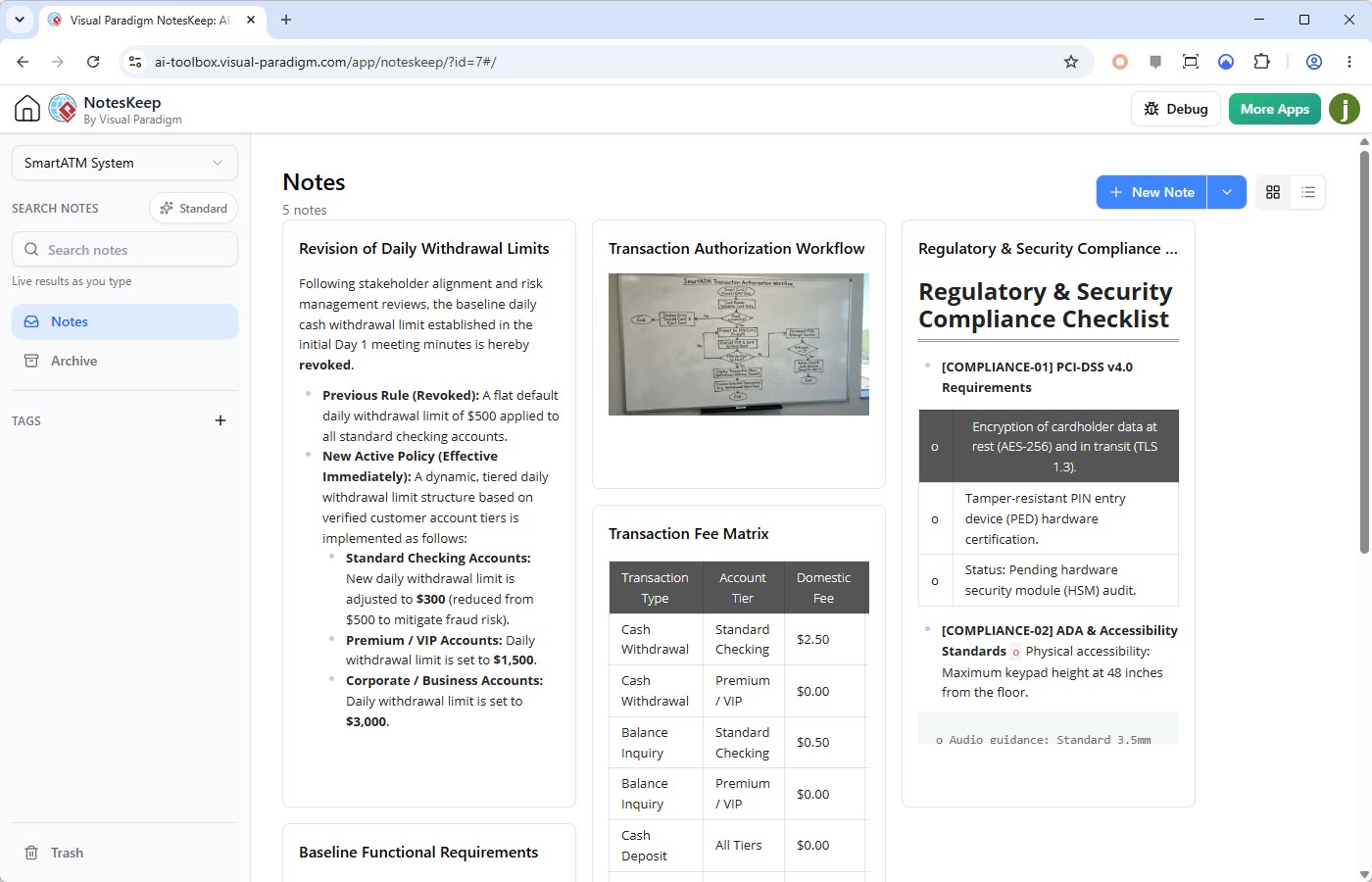
In modern project management, the transition from chaotic documentation to actionable intelligence is often the difference between project failure and success. The SmartATM System case study serves as a prime example of how teams can leverage Visual Paradigm NotesKeep to organize scattered data—ranging from regulatory PDFs to whiteboard sketches—into a coherent, AI-ready knowledge base.
This tutorial breaks down the architectural structure of the “4-Day Project Journey,” demonstrating how to model complex requirements, enforce compliance, and manage dynamic financial policies using the ecosystem’s integrated features.
1. The Architecture of Knowledge: From Silos to Insights
The core philosophy behind the Visual Paradigm NotesKeep ecosystem is the Knowledge Bridge. Traditional tools allow you to capture data, but they often fail to make it actionable. In the SmartATM simulation, we see three distinct layers of information management that converge to drive the project forward:
- Contextual Capture: Instead of storing text in isolation, notes are linked to specific system components (e.g., “Transaction Authorization”).
- Visual Enrichment: Hand-drawn logic from whiteboards is digitized and anchored to specific workflows.
- Dynamic Regulation: Hard constraints (like PCI-DSS) are stored as checklists, ensuring the design never drifts from compliance.
2. Modeling Dynamic Financial Policies
One of the most critical aspects of the SmartATM project is the handling of financial limits. The “Revision of Daily Withdrawal Limits” note demonstrates how the system handles Versioning and Policy Updates in real-time.
When requirements change, the system doesn’t just overwrite old data; it maintains a Policy State History. The architecture separates the “Previous Rule” from the “New Active Policy,” allowing stakeholders to audit changes instantly.
The implementation logic for the new tiered structure can be visualized through the following decision matrix:
POLICY: Daily Withdrawal Limits (Effective Immediately)
-------------------------------------------------------
IF Account Tier == "Standard Checking" THEN
    LIMIT = $300.00
    REASON = Mitigate fraud risk (reduced from $500)

ELSE IF Account Tier == "Premium / VIP" THEN
    LIMIT = $1,500.00
    REASON = High-value customer status

ELSE IF Account Tier == "Corporate / Business" THEN
    LIMIT = $3,000.00
    REASON = Operational liquidity needs
3. Integrating Regulatory Compliance Checklists
Security in financial systems is non-negotiable. The “Regulatory & Security Compliance” section of the notes acts as a Guardrail System. Rather than burying these requirements in a separate PDF, they are integrated directly into the project’s active notes.
This ensures that when the AI chatbot or the modeling team reviews the architecture, they immediately see constraints such as:
- [COMPLIANCE-01] PCI-DSS v4.0: Mandates specific encryption standards (AES-256 for data at rest, TLS 1.3 for data in transit).
- [COMPLIANCE-02] ADA Standards: Defines physical accessibility limits, such as keypad height (48 inches).
4. Visualizing the Transaction Workflow
The centerpiece of the SmartATM ecosystem is the Transaction Authorization Workflow. This diagram, originally sketched on a whiteboard, has been digitized and attached to the project notes. This serves as the “Single Source of Truth” for the system’s logic.
In the modeling phase, this workflow dictates the interaction between the User, the ATM Hardware, and the Core Banking System. The workflow typically follows this logic flow:
- Input: User enters PIN and Transaction Type.
- Validation: System verifies credentials against the database.
- Authorization: System checks daily limits and account status.
- Execution: Dispense cash or update balance.
By embedding this visual directly into the notes, the team eliminates the “Not Invented Here” syndrome, ensuring that the model matches the documented requirements perfectly.
5. The Role of the AI Chatbot in Decision Making
The final piece of the puzzle is the Conversational AI. In the SmartATM journey, the AI is not just a chat tool; it is an analyst. By ingesting the “Transaction Fee Matrix” and the “Withdrawal Limits” notes, the AI can answer complex queries like:
User: “What is the fee for a Premium user withdrawing $2,000?”
AI: “Based on the current policy, Premium users have a limit of $1,500. A withdrawal of $2,000 would be rejected. However, the fee for a standard $250 withdrawal is $0.00.”
Conclusion: Building a Living System
The SmartATM case study proves that effective project management is not about creating static documents; it is about building a living system where notes, models, and regulations are interconnected. By using Visual Paradigm NotesKeep, teams transform scattered information into a powerful asset that drives clarity and speed.