


In modern systems engineering, the gap between raw documentation and executable architecture is often where projects fail. Requirements get lost in PDFs, UI designs become disconnected from backend logic, and “living” specifications turn into static, outdated manuals. Visual Paradigm NotesKeep addresses this critical friction point by transforming a chaotic repository of team notes into a unified, AI-driven system engineering platform.
This tutorial explores the system architecture behind NotesKeep, demonstrating how it bridges the gap between unstructured data (like meeting minutes, bug reports, and UI screenshots) and structured modeling standards (like ArchiMate and SysML). We will walk through the core concepts of “AI-First” documentation and how to leverage the platform’s integration with Visual Paradigm’s AI Diagramming Chatbot.
1. The Core Architecture: A Unified Knowledge Graph
Traditional project management tools treat documents as isolated silos. A PDF is a file; a wiki page is a page; a drawing is a drawing. NotesKeep operates on a fundamentally different architectural philosophy: the Unified Knowledge Graph.
In this architecture, every element in the UI is a node in a larger graph. This allows for bidirectional synchronization:
- Top-Down: When you draw a system architecture diagram in the Visual Paradigm workspace, the system automatically generates corresponding requirement notes.
- Bottom-Up: When you upload a raw file (like a Word doc or a screenshot of a UI), the AI analyzes it and suggests specific architectural models or requirements that need to be modeled.
This architecture ensures that your documentation is never “dead.” It is a living specification that updates as your project evolves.
2. The AI Engine: From Raw Input to Structured Output
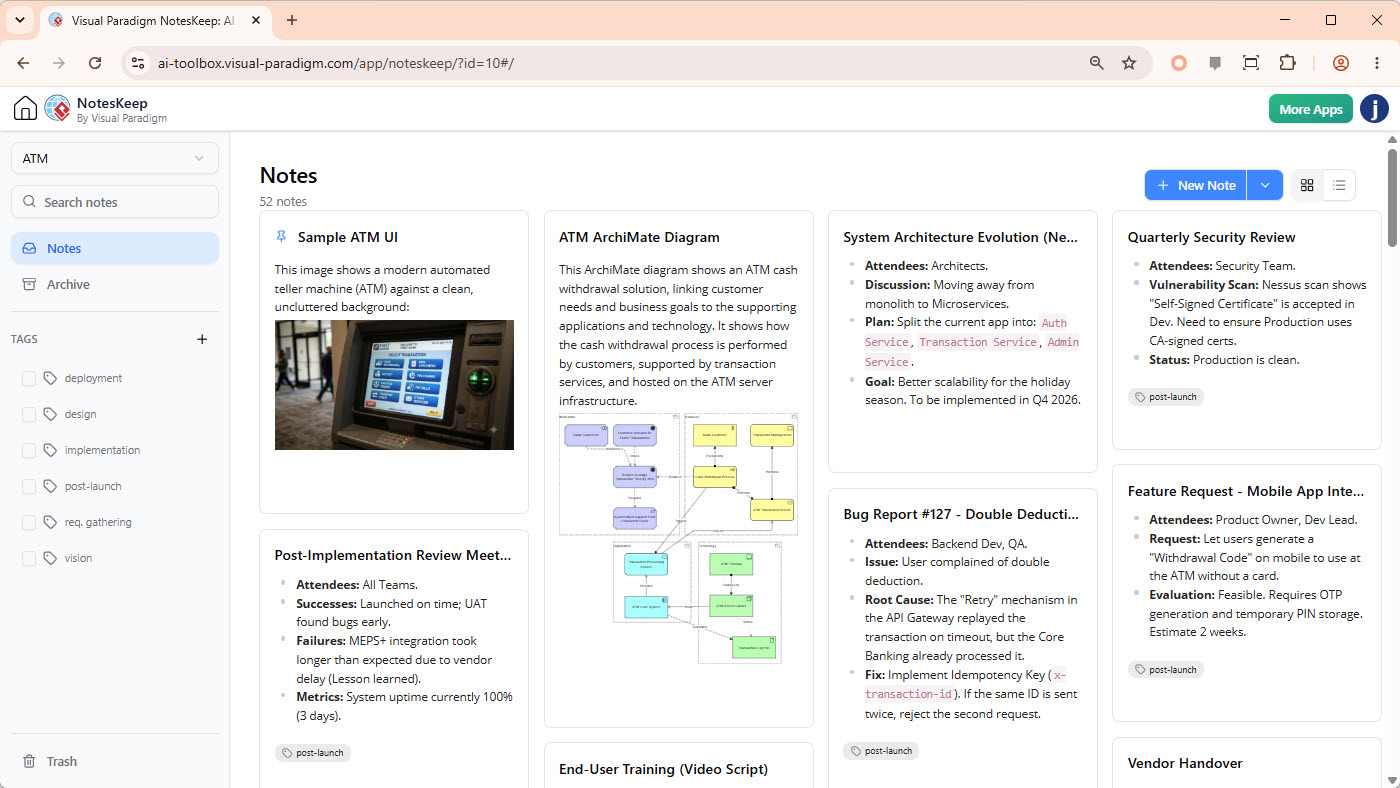
The engine driving NotesKeep is its ability to interpret unstructured text and images. Let’s break down how this works using the “ATM System” example visible in the platform interface.
Step 1: Ingestion and Classification
When a user uploads a file or types a note, the AI first classifies the content. It looks for keywords to determine the type of engineering artifact.
- Input: A screenshot of an ATM screen labeled “Sample ATM UI.”
- AI Action: Recognizes this as a User Interface Requirement. It extracts the visible buttons and flow logic.
Step 2: Semantic Mapping to ArchiMate
The system maps these extracted entities to standard modeling languages. In the screenshot, we see an ATM ArchiMate Diagram. This is not a random drawing; it is a semantic mapping of the business processes.
The AI identifies specific ArchiMate layers:
- Business Layer: “Cash Withdrawal” (The user action).
- Application Layer: “Transaction Service” (The software logic).
- Infrastructure Layer: “ATM Server Infrastructure” (The physical hardware).
3. Integrating System Evolution and Security
One of the most powerful features of NotesKeep is its ability to handle System Evolution and Security Compliance as first-class citizens, rather than afterthoughts.
Tracking Evolution
Notice the “System Architecture Evolution” note in the interface. It tracks the transition from a monolithic architecture to microservices. This is critical for technical debt management. The note explicitly lists the target services:
- Auth Service
- Transaction Service
- Admin Service
This allows architects to visualize the “As-Is” vs. “To-Be” states within the same interface.
Security by Design
Security is not just a checklist; it is a requirement node. The “Quarterly Security Review” note integrates directly with tools like Nessus (a vulnerability scanner). The note captures the specific finding: “Self-Signed Certificate is accepted in Dev.”
This creates a traceability link: Requirement → Vulnerability → Fix Strategy.
4. Implementing Resilience: The Bug Report Workflow
Let’s look at how NotesKeep handles complex logic, such as the “Bug Report #127” regarding double deduction. This demonstrates the platform’s capability to handle logical dependencies.
The Problem: The “Retry” mechanism replayed a transaction on timeout, causing a double charge.
The AI-Assisted Fix: The solution involves implementing an Idempotency Key. This is a critical pattern in distributed systems.
To model this in Visual Paradigm, you would typically use a decision table or a sequence diagram to represent the Idempotency logic. NotesKeep allows you to link this bug report directly to the diagram element that fixes it.
// Conceptual Logic for Idempotency Key (Linked to Bug Fix)
function processTransaction(transactionData) {
    const idempotencyKey = transactionData.id;

    if (transactionStore.exists(idempotencyKey)) {
        return transactionStore.get(idempotencyKey); // Return cached result
    }

    result = executeCoreBanking(transactionData);
    transactionStore.save(idempotencyKey, result);
    return result;
}
By linking the text description to the code logic, NotesKeep ensures that the “Fix” is not just a text description, but a verifiable implementation requirement.
5. Practical Application: Building Your Own Unified Spec
To replicate this workflow in your own organization, follow these steps:
- Centralize Ingestion: Stop emailing PDFs. Upload all raw requirements, meeting minutes, and UI mockups into NotesKeep.
- Tag and Tag: Use the tagging system (e.g., deployment, design, implementation) to create a semantic filter for your data.
- Trigger AI Generation: Use the “AI Diagramming Chatbot” to ask: “Create an ArchiMate view of the ATM Cash Withdrawal process based on the uploaded notes.”
- Validate Architecture: Review the generated diagram against your “System Architecture Evolution” goals.
Conclusion
NotesKeep represents a shift from “Document Management” to “Knowledge Management.” By converting scattered documents into living specifications, it empowers teams to maintain a single source of truth. Whether you are tracking the evolution of an ATM system or managing complex security vulnerabilities, the platform ensures that your documentation is as dynamic and robust as the software you build.