


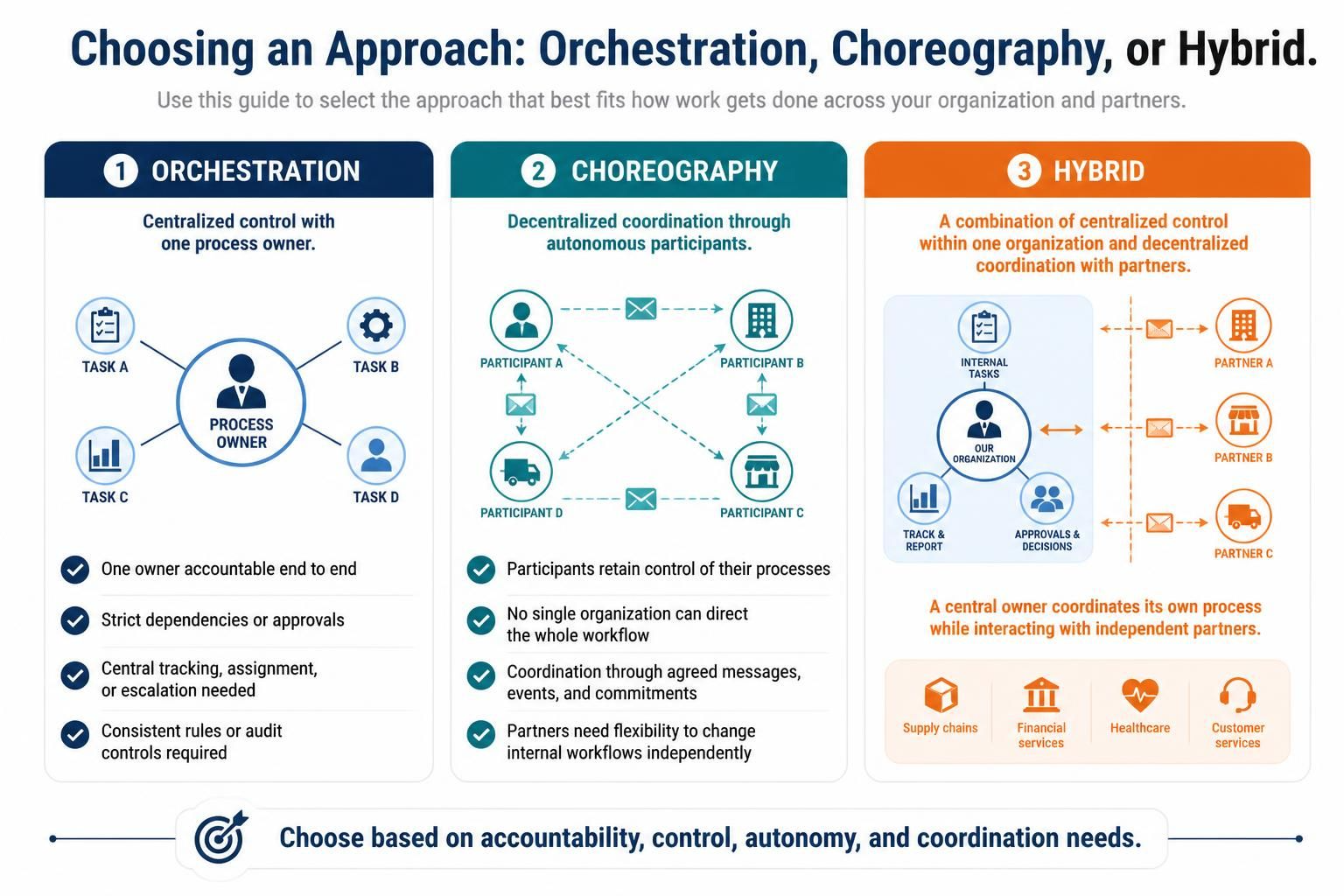
In the realm of Business Process Management (BPM), selecting the correct coordination pattern is as critical as the process logic itself. Whether you are designing a simple approval workflow or a complex supply chain integration, the choice between Orchestration, Choreography, and Hybrid architectures defines the flexibility, accountability, and technical complexity of your system.
This tutorial breaks down these three distinct approaches, helping you visualize when to apply centralized control versus decentralized autonomy.
1. Orchestration: The Centralized Conductor
Orchestration is the most common pattern in BPM. It relies on a Process Owner—a central service or role—that acts as the “conductor” of the entire performance. This owner is responsible for maintaining the state of the process and telling every participant exactly what to do next.
When to Use Orchestration
- End-to-End Accountability: You have a single entity that must be responsible for the final outcome.
- Strict Dependencies: Task B cannot start until Task A is completed and approved.
- Centralized Tracking: The business requires a unified dashboard to see the status, assign work, or escalate issues.
- Compliance & Audit: You need to apply consistent rules, security checks, or audit trails across the entire workflow.
Visualizing Orchestration
In a BPMN diagram, this looks like a central hub (often represented by a Service Task or a specific “Controller” pool) with outgoing flow arrows to all other participants. The participants do not know the “big picture”; they only know their specific instruction.
2. Choreography: The Decentralized Dance
Choreography flips the script. Instead of a central director, each participant acts independently. Coordination is achieved through the exchange of messages, events, and mutually agreed-upon commitments. No single organization has the authority to direct the entire workflow.
When to Use Choreography
- Autonomy: Participants are independent entities that retain full control over their internal processes.
- Distributed Authority: No single organization can legitimately direct the whole workflow (common in cross-organizational scenarios).
- Event-Driven: Coordination depends on messages and events (e.g., “Order Placed”, “Payment Received”).
- Flexibility: Participants need the room to change their internal workflows without renegotiating every step with the entire network.
Visualizing Choreography
In diagrams, this appears as a mesh of interactions between participants. You will see Message Flows connecting different pools. Each participant holds its own “role” in the process, and the global process emerges only from the sum of these interactions.
3. Hybrid: The Best of Both Worlds
Real-world systems rarely fit neatly into just one box. The Hybrid approach combines centralized control within one organization with decentralized coordination with external partners. This is the standard for complex ecosystems like supply chains, healthcare networks, and financial services.
Architecture of the Hybrid Model
In this model, your organization acts as the orchestrator for its internal tasks (approvals, reporting, internal logic) but switches to a choreography model when interacting with external partners.
- Internal Loop: “Our Organization” coordinates its own tasks, ensuring strict compliance and tracking.
- External Interaction: “Our Organization” sends requests to Partner A, B, or C, but does not dictate their internal execution.
- Asynchronous Communication: Partners respond via events, allowing them to operate on their own schedules while keeping the central process informed.
Common Use Cases
- Supply Chains: A manufacturer orchestrates internal production but coordinates with independent logistics providers.
- Financial Services: A bank manages its own compliance workflow but choreographs fund transfers across different banking networks.
- Customer Services: A digital service manages the user interface and internal logic but delegates specific data processing to third-party APIs.
Conclusion: Choosing the Right Path
When modeling your systems, ask yourself: Who is accountable? If the answer is “one person or team,” go with Orchestration. If the answer is “a network of equals,” choose Choreography. If you are managing a complex ecosystem, adopt a Hybrid approach.
By aligning your architectural pattern with your business needs, you ensure that your BPM system is not just a diagram, but a resilient engine for value creation.